What is Economic Abuse?

Table Of Contents
What is Economic Abuse?
Economic abuse is a form of power and control in intimate relationships. Economic abuse is part of coercive patterned behaviour, making the victim economically dependent on their partner. Previous research has indicated that when economic abuse is present, there is a likelihood of some other form of abuse, which could include abuse that is physical, coercive, emotional, or sexual in nature. Economic abuse is a unique form of intimate partner violence. Economic abuse may limit one’s ability to leave a relationship. Economic abuse can continue once a couple has separated. Economic abuse is experienced by people of all genders, sexualities, religions, races and socioeconomic levels.
- 19% of Canadians between the ages of 15-64 reported experiencing emotional or financial abuse from an intimate partner at the same time.
- 51% of survivors staying in residential facilities reported having experienced financial abuse.
- CCFWE’s research study in the Greater Ottawa region reported 95% of women who experience domestic violence were also likely to experience financial and economic abuse.
- CCFWE’s national study reported 46% of respondents experienced harassment and disruption at work, 52% reported that their partner demanded to know where money was spent, and 51% reported that partners were misspending money that was designated for bills
Controlling mechanism
Economic abuse is often used as a controlling mechanism as part of a larger pattern of domestic abuse, which may include verbal, emotional, physical and sexual abuse.
By restricting the victim’s access to economic resources, the victim has limited options to exit the abusive or violent relationship.
The following are ways that abusers may use economic abuse with other forms of domestic violence:
- Using physical force, or the threat of violence, to get money
- Providing money for sexual activity
- Controlling access to a telephone, vehicle or movement
- Isolate one from friends and family
- Threaten to kick one out of the home without financial support
- Taking advantage of one’s financial situation
- Destroy or take resources away from the home
- Blaming the victim for an inability to manage money
- Destroying things in one’s home
All races, ethnicities, abilities, and sexual orientations can be victims of economic abuse. Figure 1 shows how Economic Abuse can be used to assert power and control over someone else:
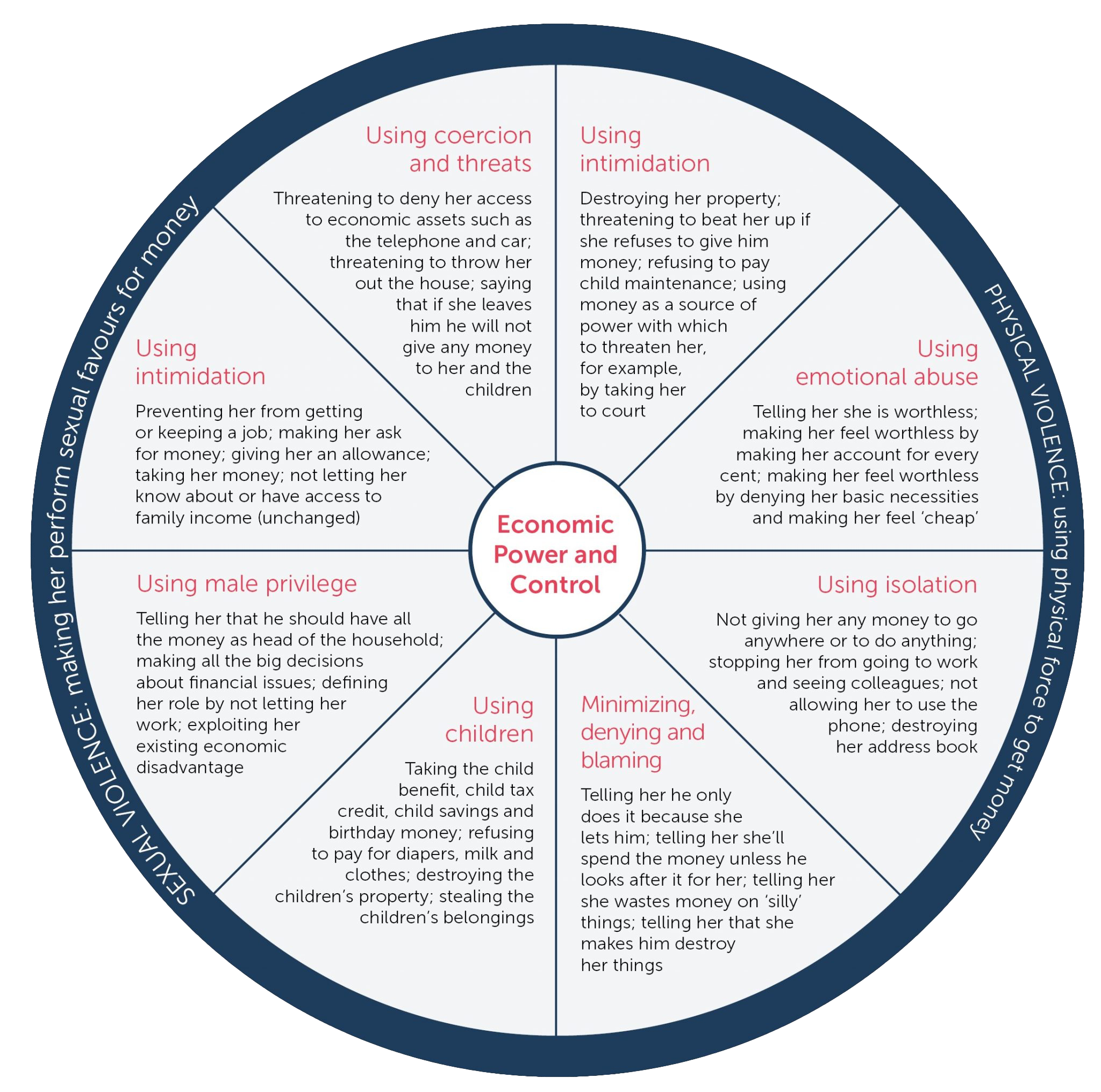
Economic Power and Control Wheel
[With permission from: Domestic Abuse Intervention Program, 202 East Superior Street, Duluth, Minnesota 55802, 218-722-2781 www.theduluthmodel.org]
Economic Abuse Tactics
Behaviours that make it harder for a victim to get, use, and keep resources, putting their financial security and independence at risk.
Tactics
- Sabotaging childcare, transportation, or one’s job
- Bothering you at work- too many phone calls, showing up unannounced and uninvited
- Refusing to get a job and spending all of the money
- Excluding you from family financial planning
- Not allowing you access to the family finances
- Making you ask for money or taking your money
- Demanding to see the receipts of all purchases
- Controlling your access to financial information
- Not allowing you to talk to others about money
- Preventing your name from being on accounts
- Forcing you to put your name on credit cards or bank accounts and spending all the money and subsequently refusing to pay
- Making fun of the amount of money you make and making fun of your contribution to the home
- Expecting you to behave in a certain way because you make less money or are not the “breadwinner”
- Preventing you from learning English or French
- Forcing you to work when you do not have a work permit or work authorization in Canada
- Threatening to report you to police if you work without a work permit
- Taking the money you are planning on sending your family back home
- Forcing you to sign papers in English/French that you do not understand. For example, court paper or immigration papers

What is Financial Abuse?
Financial abuse occurs when a partner uses or misuses your (or the family’s) money. This can happen without your permission or knowledge Financial abuse can include using credit cards without permission, putting contractual obligations (like debts, lines of credit or mortgages) in their partner’s name, and gambling with family assets.
Both economic and financial abuse often leaves victim-survivors unable to afford basic essentials such as food and clothing, without access to their own bank accounts, and without access to any independent income as debts may have been built up by abusive partners.
Difference between Financial and Economic Abuse
Behaviours that control, exploit, and sabotage an individual’s resources are examples of economic abuse. They restrict the individual’s autonomy and independence.
Economic abuse includes a wider range of behaviours that have an impact on employment, food, medicine, and housing as opposed to financial abuse, which typically focuses solely on money.
Both economic and financial abuse often leave victims unable to afford basic essentials such as food and clothing, without access to their own bank accounts, and without access to any independent income as debts may have piled up by abusive partners.
What is economic exploitation?
Occurs when your partner intentionally destroys the victim’s credit or financial resources.
Tactics
- Stealing money, checks, or bank/credit card
- Opening or using victim’s line of credit without permission
- Refusing to pay bills or running up bills under the name of the victim or theiR children
- Gambling with jointly earned money
What is employment sabotage?
Occurs when your partner prevents you from getting a job or keeping a job, or going to school.
Tactics
- Forbidding, discouraging, or actively interfering with the victim’s employment and/or educational efforts
- Harassing the victim at their job
- Blocking income supports such as child support, public assistance, or disability payments
What is economic control?
Occurs when the perpetrator restricts the victim’s ability to make financial decisions and prevents them from knowing about the family’s finances.
Tactics
- Controlling and limiting the victim’s access to financial resources
- Denying the victim access to necessities, such as food, clothing, and/or medications
- Your partner keeps track of how you spend money – for example asking for receipts after grocery shopping
- Not allowing the partner to access joint bank accounts
- Lying about assets and properties that are jointly owned
What does economic abuse look like when it is experienced post-separation?
Economic abuse, in contrast to physical or sexual abuse, can continue long after a person leaves an abusive relationship. The ongoing fear of abuse from a past partner can lead to coerced debt by using threatening tactics, harassment and intimidation. Even after a breakup, abusive partners may try to maintain control by adopting controlling behaviours.
Tactics include:
- Refusing to remove a partner’s name from utility accounts and other bills,
- Intentionally prolonging the divorce process to increase costs for survivors
- Taking out expensive loans to avoid having to pay for spousal or child support
- Further accumulation of debt on joint accounts or credit for which both parties are jointly liable
- Withholding their personal documents (for example, visas, passports, and birth certificates.
- Blocking access to joint economic resources
- Refusing to negotiate terms on joint financial products
- Using others’ bank accounts to conceal financial resources
- Removing all money from joint accounts/savings/children’s savings
- Using ‘loopholes’ in legislation to protect their assets
- Refusing to pay child support despite having financial resources
- Concealing/refusing to disclose actual income.
- Hiding assets in a family members name
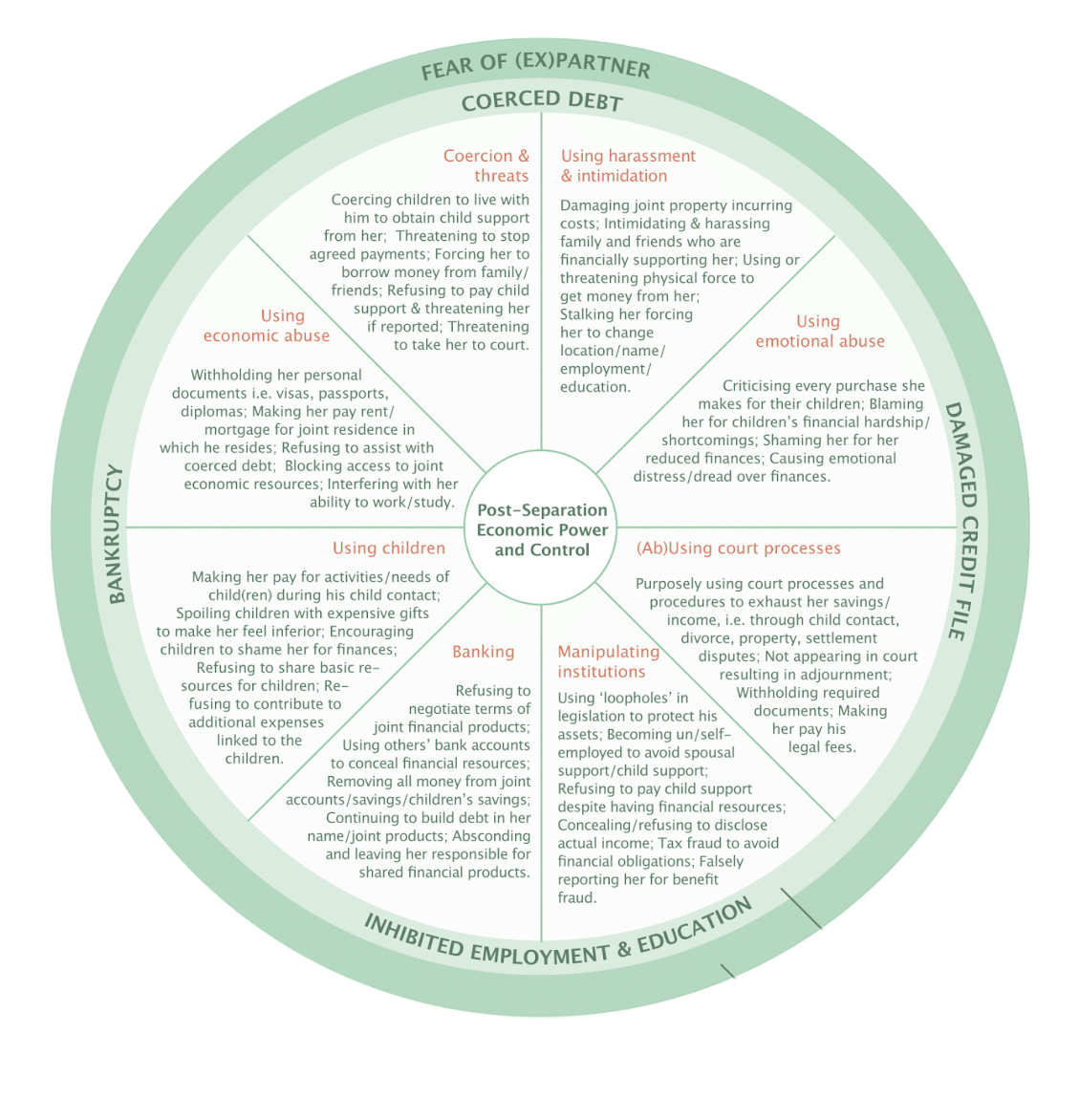
Post-Separation Economic Power and Control Wheel
[Developed by Jenn Glinski, University of Glasgow (2021). This resource is based on research findings of University of Glasgow PHD candidate Jenn Glinski, who is currently completing her thesis. Illustration design by Tony Mamo. Adaptation of the original Power and Control Wheel; approved by The Domestic Abuse Intervention Programs, www.TheDuluthModel.org]
What are the impacts of economic abuse?
Women’s experiences of economic abuse and the effects of these experiences on their lives are varied and complex. The impacts can be physical, emotional, mental and economic.
Emotional & Mental Impact:
According to a 2019 report from Statistics Canada, at least 50% of women in shelters for victims of intimate partner violence (IPV) have also been victims of economic abuse. It is a method of psychological coercion which leaves victims terrorized, disempowered, and mentally unwell. Unlike other forms of IPV, economic abuse often continues long after a relationship has ended. Due to the enduring stigmatization of conversations around money, it is also the least spoken about form of abuse.
Victims who are controlled economically and have been unable to flourish will feel as if there will never be enough money. As a result, high levels of anxiety, fear, and stress tend to prevail, which causes impacted-victims to make more unwise decisions, or results in an inability to see long-term financial solutions. Economic abuse has unique impacts on the mental health of victims. Post Traumatic Stress Disorder is 7 times higher in relationships where economic abuse has occurred. Economic abuse is also the strongest indicator of suicide attempts for women in abusive relationships. Abuse also contributes to a scarcity mindset.
Economic Impact: Poverty, homelessness, debt, damaged credit, and bankruptcy. The impact of economic abuse on a victim’s financial security can be long-lasting. It doesn’t necessarily end when the relationship does. The impacts can delay financial recovery and become economically independent. Interference with education and employment can make it difficult to find or keep a job. After separation, an abuser may use family law and child support to control and damage a victim’s financial security and independence. Victims may also be left responsible for debts built up by their ex-partner, making it harder to secure suitable housing, get a loan for a car, and cover day-to-day living expenses. Economic abuse can contribute to a lifetime of economic struggle for victims. Some are left homeless, unemployed, and unable to access resources to rebuild their lives. It can result in staying with an abusive partner longer than anticipated, resulting in more harm.
What is domestic/family violence?
Domestic violence is a serious threat for many individuals, particularly women. Know the signs of an abusive relationship. Intimate partner violence (IPV), also known as domestic violence, occurs between intimate partners. There are many different kinds of domestic violence, including physical, emotional, and sexual abuse, as well as threats of abuse. Anyone can be abused by a partner, but women are the most common victims of domestic violence. Both heterosexual and same-sex relationships can experience domestic violence.
In abusive relationships, there exists a power and control imbalance. To exert control over a partner, an abuser uses intimidating and hurtful words and actions.
At first, it might not be easy to recognize domestic violence. Abuse often begins subtly and gets worse over time, even though some relationships are clearly abusive from the start. You may be experiencing abuse if you’re in a relationship with someone who does any of the following:
- Calls you names, insults you, or puts you down
- Prevents or discourages you from going to work or school or seeing family members and friends
- Tries to control how you spend money, where you go, what medicines you take, or what you wear
- Acts jealous or possessive or constantly accuses you of being unfaithful
- Gets angry when drinking alcohol or using drugs
- Threatens you with violence or a weapon
- Hits, kicks, shoves, slaps, chokes or otherwise hurts you, your children or your pets
- Forces you to have sex or engage in sexual acts against your will
- Blames you for his or her violent behaviour or tells you that you deserve it
If you’re in a relationship with someone of the same sex or if you’re bisexual or transgender, you could also be the victim of abuse. Here are some examples of abuse in this context:
- Threatens to tell friends, family, coworkers, or members of the community about your sexual orientation or gender identity
- Informs you that the authorities will not assist you as a result of your sexuality or gender identity
- Justifies abuse by questioning your sexuality or gender identity
Technology Facilitated Intimate Partner Violence (IPV)
The ability to access technology such as a cell phone or computer can be a lifeline for individuals in abusive relationships. It is vital for people to have access to these tools to allow survivors to find support though friends, family, and mental health services.
It’s important to note that technology can also be used with malicious intent by current or former partners, to abuse, humiliate and control victims. It can also be used to monitor a person’s communications and activities without their knowledge.
Warning Signs
Some warning signs of technology facilitated abuse include the following:
- A person seems to know what you are doing online when they normally would not have access to this information.
- Knows where you or your children are or turns up unexpectedly where you are
- Knows information that was disclosed in private conversations, messages or emails
- Has access to your phone or computer or requests passwords or pin codes
- If a current or ex-partner has access to a victim’s phone, they can also view call logs, emails, texts, browser histories and can load spyware onto a device
Here are a few questions to ask yourself that could help to identify if economic abuse is taking place or could begin to take place:
- Have your passwords stopped working or has access to any of your online accounts suddenly been restricted?
- Have you unexpectedly been given a computer or phone or received offers to fix your devices?
- Have your children been given new electronic gifts that your ex-partner seems insistent on using and taking said device with them when they return to your care? Sometimes a phone with location tracking is given to a child when there is a separation
- Are you receiving abusive emails, messages, or texts from strangers or anonymous senders?
If you answered yes to any of the above and you feel unsafe, the following is a list of suggestions on how to maintain your safety when using technology and provide contact information for a number of support services.
Ways to Protect Yourself:
On all Devices, set strong passwords (which are a combination of numbers, letters, and symbols or a non-obvious combination of numbers in the case of PINs. It is advisable not to use birth years, birthdays, or familiar names in numeric format as PINs), turn off location services, consider using a safe device such as a prepaid phone and install anti-spyware, anti-virus, or anti-malware protection. This applies to all devices, including those used by children.
While browsing the Internet: Use the private browsing option, delete your browsing history, and if you cannot use the Internet at home, use the internet at a safe place, such as a trusted friend’s place, internet cafes or the library.
When creating and using email: create a new email address that does not use your real name, or use a trusted friend or family member’s account. This is important for safety planning in the event you need to set up a bank account. Also be cautious when opening attachments or clicking on links in emails from senders you do not know.
When using social media: avoid posting identifying information, including photos of yourself or your children. Block unknown or hostile people, and use the highest level security and privacy settings on your accounts to make sure your posts are only seen by the people you choose. Only add ‘friends’ you trust not to communicate with your former partner. Ensure your location is not shared, by going into Settings and disabling Location Services from being accessed on the app.
It can be challenging and intimidating to navigate where to seek help, what options exist, and how to potentially escape an abusive person or situation. It is important to know there are many options for accessing resources and support and while online options can make it easier to access support, there are also some considerations for ensuring your privacy and safety while using them.
Enter your PIN
Search


Trending Interiors: beige tones


Family Style Jollof Rice for your next gathering

Easy To-Go Breakfast


Fun DIY Packaging for your next big event


10 MUST TRY recipes for a gathering with friends

10 MUST TRY recipes for a gathering with friends


Top travel destinations for backpackers


Minimalism Decor Trend 2023

EASY: Follow Along Sweater Pattern


Cozy Chunky Knits Catalogue

Cozy Chunky Knits Catalogue

Cozy Chunky Knits Catalogue

DIY Event Decor: Beginner

Minimalism Decor Trend 2023

Couches for every type of living room
